
Read: Broadway Presents 250 years of the Boston Tea Party
A June 2026 NDN Book Club Reflection on Playing Indian by Philip J. Deloria written by Co-Initiator Chingwe Padraig Sullivan
It’s a cold, rainy December evening. The sun has set, the tide is so low as to be mud, and the city of Boston is lit by lamplight. It’s 1773, and there’s a throng of white men in redface storming ships stuffed to the gills with lead-lined boxes of nearly-expired black tea. We watch, stoically, the only two actual “Indians” present. Myself, and my spirit guide – the ghostly apparition of Philip J. Deloria, played of course by Johnny Depp, in full Tonto. (I wanted to get actual Philip J. Deloria, but test audiences felt Depp was more authentic. A Harvard professor with short grey hair and a sport coat just doesn’t read as Indian, apparently). Depp-Deloria and I are both conducting first-person historical research, though for reasons of massively different importance. He’s writing the preface for a new edition of Playing Indian. I’m there because I’m a 24-year-old theatre actor being paid 15 dollars an hour to guide tourists on a heavily-priced, sanitized, seventy-five-minute Boston Tea Party experience. I’d spent the last few minutes excitedly talking to Depp-Deloria about the fun inversion of the event created by my being there – an Indian playing a white man playing an Indian – but Depp-Deloria can only speak in a mix of quotes from The Lone Ranger and Playing Indian, so instead of a discussion he’s been nodding, stoically.
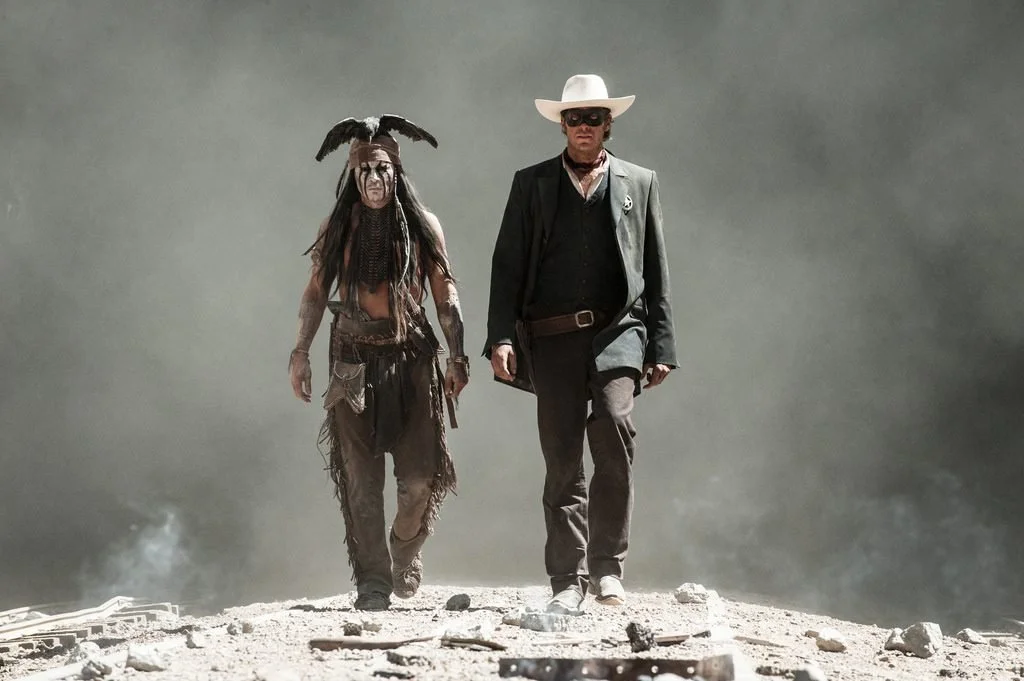
Johnny Depp in The Lone Ranger (2013)
We both watch the roughly 100 men playing Iron Eyes Cody on those ships and understand they’re enacting a massive moment of political theatre, but Depp-Deloria’s focus (which is by far a more comprehensive and well-reasoned one than mine, don’t be fooled by the reductive shape he’s been forced into by the narrative) on how this performance acts as a way for these men – and their audience – to attempt to define what it means to be “American”. He speaks, quoting directly from Patriotic Indians and Identities of Revolution, the first chapter of his book:
“On an early winter night in 1773, white male Americans staked a unique and privileged claim to Liberty and nationhood. They acted through the channels cut by European traditions…that they made their own through the use of Indian Others. The Tea Party represents the culmination of colonial Indian play.”
The word “play” sticks with me. He doesn’t mean my narrower kind of play, the kind done on a stage, with a script – his definition is a broader one that encompasses masquerade and performance in the streets, a version of play that includes literally playing. Having fun. But my mind is already on a tangent focusing on the kind of play I do. I have the dawning realization that in the 250 years since this night, the only thing that’s really changed is the venue.
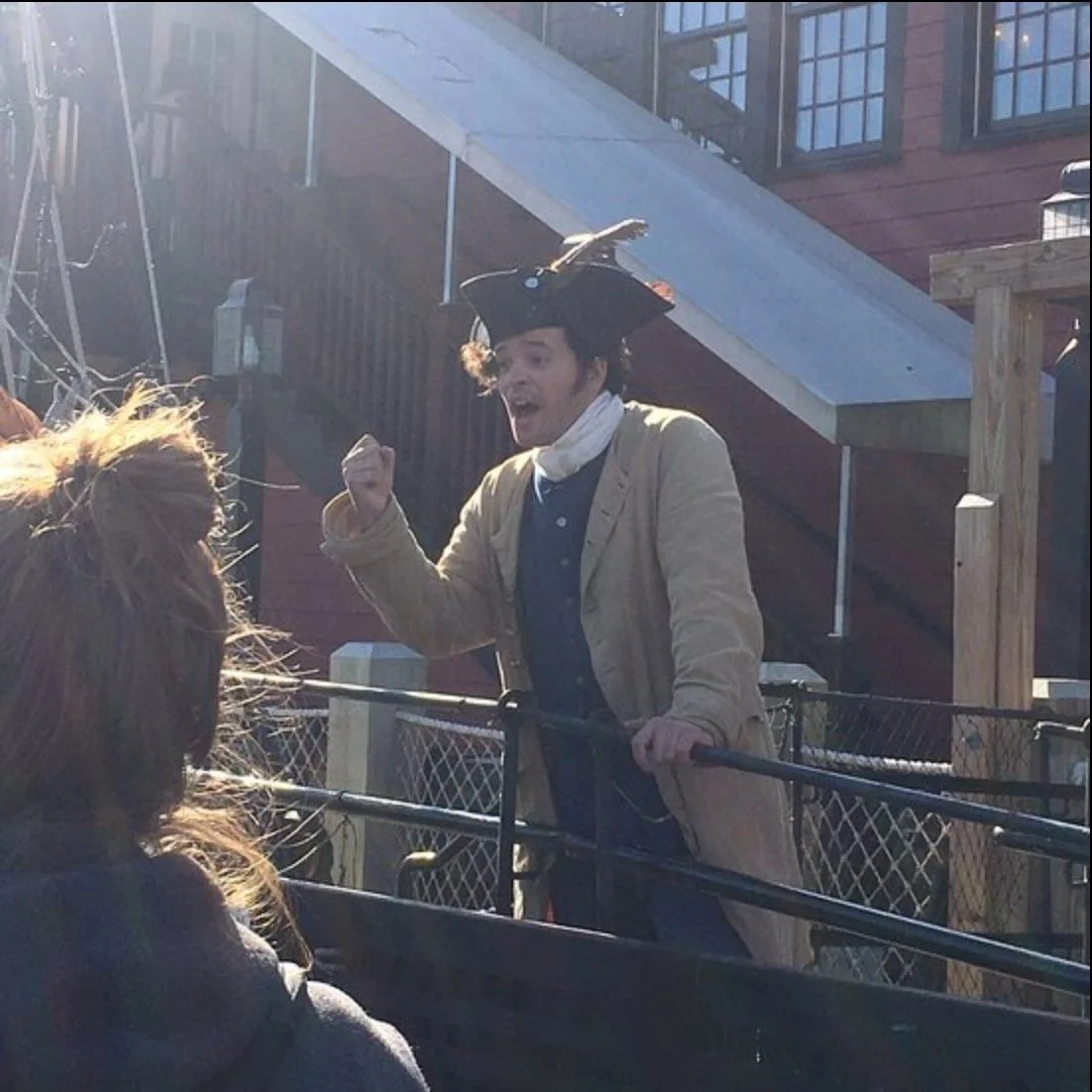
Chingwe Padraig Sullivan playing Thomas Melville at the Boston Tea Party Museum (2017)
These are the thoughts I share with Depp-Deloria.
The entire concept behind the recent(ish) push for representation in media is that all people deserve to tell their own stories. It’s an affirmation that there is the same intrinsic human value in a Shakespeare as there is in August Wilson. Yet representation for marginalized groups, and especially Native people in the US is at an all-time low. Native artists made up zero percent of the actors on Broadway in 2025. The first Broadway play written by a Native American woman was Larissa Fasthorse’s The Thanksgiving Play, and that was produced in 2023. Fasthorse has written many plays, but that’s the one that gets produced the most, and it’s the only one that’s made it to Broadway. Why that one? Why not the rest? It’s worth noting that it’s the only show of hers where the cast is entirely white. Oklahoma!, Rogers and Hammerstein’s lauded first collaboration had a Broadway premiere in 1943, and has since been revived on Broadway four times. It was adapted from an earlier play, Green Grows the Lilacs, written by Lynn Riggs, a Cherokee citizen. Green Grows the Lilacs ran on Broadway for two months in 1943. The more palatable version of his story was the musical by white men. The quiet message is that our voices and bodies are only needed or wanted on the “American” stage when they’re serving to reinforce the American colonial narrative.
And the Boston Tea Party is why.
“Not by itself, obviously,” I say to Depp-Deloria. “But indulge me in my rambling for a moment, please?”
Growing up, I always knew that this country preferred a certain kind of “Indian”. Massachusetts is not a subtle state in its ouroboric love of its own colonial history. Pilgrims in buckle hats, Plymouth plantation, the “first Thanksgiving.” These are technically our stories. But they’re not, actually. They’re not even really about us – we’re not even really there. Indians in these stories are almost entirely fictitious, the noble savage that real-world Deloria identifies as an Indian Other that is useful to the white American precisely because it’s just a red wrapper over a white fantasy. Removing us from representations of ourselves allows the white colonist to step in, and wear the wrapper themselves, simultaneously exterminating and replacing us. This extends to the majority of our appearances on TV and in the movies. Every Indian in a documentary or western is only a half-step away from being another Tea Party “Indian” or Iron Eyes Cody, and that’s not counting at least 48 times between 1927 and 1990 it was, literally, Iron Eyes Cody (who was, in reality, a second generation Italian-American named Espera Oscar De Corti). We’re not the target audience for these stories. The target audience is the white American colonial anxiety that pays hundreds of dollars a ticket to see Oklahoma!.
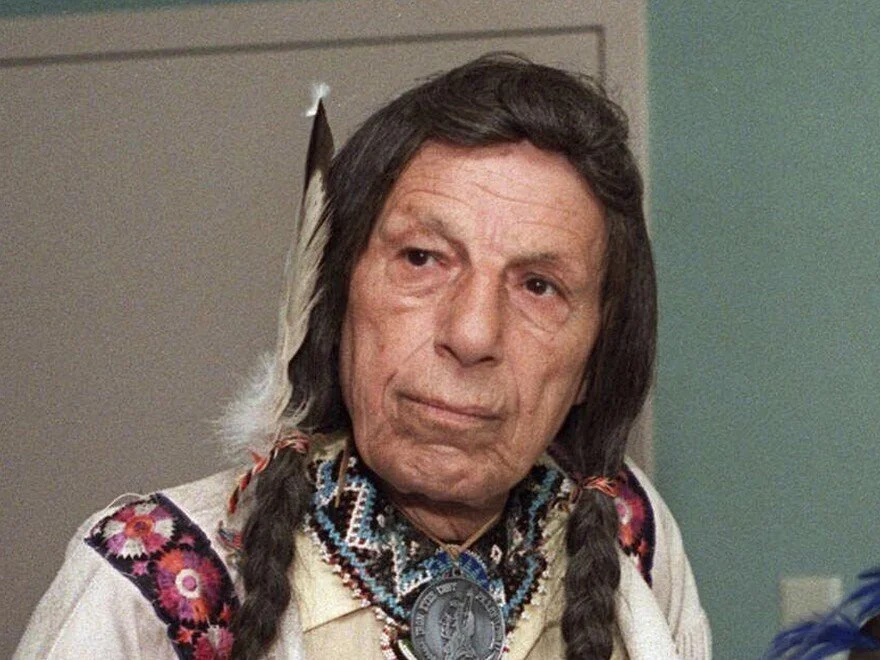
Espera Oscar de Corti as “Iron Eyes Cody” or “The Crying Indian” from the anti-pollution ads
It’s no longer okay, of course, for white folks to dress up and pretend to be us. Which, I tell Depp-Deloria, is my theory as to why authentic Native stories told by brilliant and talented Native artists, don’t make it to Broadway. Or even Off-Broadway. They can’t be us anymore, so they don’t want to see us. Seeing us would mean having to acknowledge our existence as real people, and obliterate the colonial fictions that America sits on.
Depp-Deloria nods and continues to look stoic, as it’s the only facial expression he’s allowed to make. I think that’s the end of it, until he speaks up, this time from the chapter Hobby Indians, Authenticity, and Race:
“Yet these were engagements not only with authentic identity, but with racial anxiety. People hobbyists knew that Indians occupied the same time and place as themselves and to gain access to a racially defined authentic, it also threatened the sense of difference that defined Indian Others. For if culture was behavioralist in nature, what happened when Indians (or Latinos or African Americans or Asian Americans) altered their behavior, trading in acts marked both as racially distinctive and authentic for those unmarked and therefore white in the absence of firm lines around blackness and redness, the very notion of being white became unstable.”
That’s the closest Depp-Deloria could get to saying “I agree”, and I yell out a joyful cheer that gets lost in the sea of grown men yelling “Huzzah!” as they successfully destroy other people’s property to protect their own business interests. A chill creeps into my bones alongside his approval as I realize what this means for our place in the American media landscape. We’re allowed in westerns and historical dramas, where we play out the Indian Other. Every once in a while, we get brilliant authentic representation on TV – Reservation Dogs, North of North, Rutherford Falls – which inevitably gets cancelled (though North of North has been greenlit for a second season! Watch it or Depp-Deloria and I will haunt you. North of North also is Canadian, but I’ll take what I can get). TV and streaming services are also a low cost of entry for audiences – you pay for a streaming service, and our stories get bundled alongside all the other white-centric media that’s on there. In a bang-for-your-buck analysis, you get to experience authentic Indians from the safety of your own home, for free! That distance between the white audience and the televised Indian is in a sense almost creating a modern, digital version of real-Deloria’s Exterior Indian. Our authenticity belongs at a distance, not up close and onstage.
And it makes sense, doesn’t it? Native representation flounders on the “American” stage due to 250 years of white insecurity. Our voices are only prioritized when they’re useful to the grand traditions of art and entertainment - when we’re modernizing and reinforcing the fake versions of us necessary to keep the “American” identity alive. Our voices are only valuable when they’re not directly challenging “American” identity.
I look at Depp-Deloria, a panic creeping in the back of my throat.
“Is this all we are?” I ask. “Is this what we’re doomed to be when we try and tell our stories? Either a distant Other or a close-up puppet?”
He looks at me as the gaggle of future sports mascots around us finish their work and march off the ships. He opens his mouth to speak and for the first time I hear Johnny Depp’s half-assed fake-Indian dialect.
“Don’t be stupid.”
He’s right. That’s an absolutely stupid conclusion to make. It’s the only takeaway the white American narrative wants us to be audience for in their westerns and historiographies and rewrites of our history. That we should give up, because our stories either don’t matter, or belong to white America, the ultimate victors of all history, and we should be happy we even get to do our little TV shows.
Fuck that.
Depp-Deloria and I will see you on Broadway.