
Read: Stuck at Sovereignty
Written by co-Initiator Tara Moses
When I first sat down to write this month’s reflection on our NDN Book Club selection I figured that I would break down the politics and rippling impacts from centuries of tribal law that we as contemporary Native people continue to experience, and how that affects how we function as artists. Frankly, when we decided to select Mary Kathyn Nagle’s play, that was our thinking as well. Sovereignty is an important play in the theatrical canon and in the history of contemporary Native theatre. It is widely considered to be the play that launched the Renaissance of Native theatre in this country.
Sovereignty by Mary Kathryn Nagle breaks down complicated tribal jurisdiction history while showcasing the real impacts on Native people today. Violence against Native women (and in particular the Violence Against Women Act), constant battles over jurisdiction (which still remain relevant, even after the landmark Supreme Court case McGirt v. Oklahoma in 2020), and the rippling consequences from the Andrew Jackson administration all continue to impact our lives. By weaving throughout centuries of real stories, Sovereignty takes audiences through widely unknown (and ignored) history. It’s a foundational piece of Native theatre.
MAJOR RIDGE
When I speak my language, that’s sovereignty. When I sit on Council and vote on a resolution, that’s sovereignty. When I vote to elect our Principal Chief, that’s sovereignty. And when I bury my parents in the same soil that my parents buried their parents in, that’s sovereignty. Sovereignty is our right to be who the Creator intended us to be.”
Sovereignty by Mary Kathryn Nagle
Following the world premiere production at Arena Stage in early 2018 (and the first original Native-authored play produced at a LORT theatre in nearly a decade), there is a clear timeline of other theaters also producing their first Native-authored plays throughout the country, which led to the first play by a Native woman on Broadway, and countless more yet-to-be announced plays in upcoming seasons. Many Native artists credit that production as the genesis of this Native Theatre Renaissance - I am firmly among those who do. I was fully prepared to write a reflection about why and how the legal issues Mary Kathryn Nagle writes about radiate into the work of many Native artists today. However, as I re-read Sovereignty nearly a decade after that seminal production, I was left feeling the same doubt, fear, frustration, and concern for our sovereignty as Native artists in the theatre that I felt when I first read it - and I was transported back to 2016.
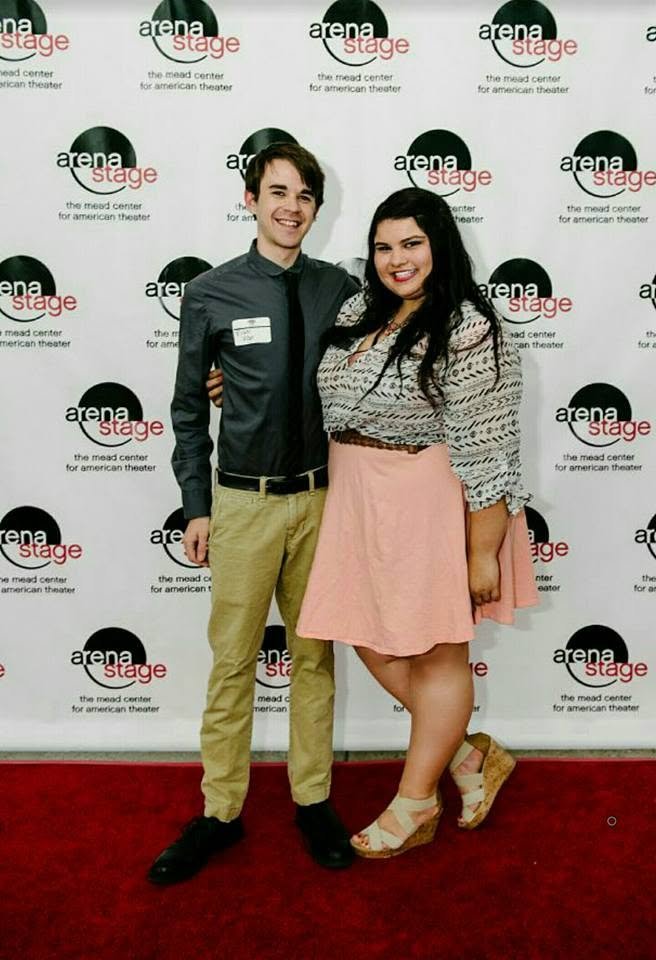
Ryan Fox and Tara Moses at Arena Stage, 2016.
I was a first generation college graduate, in my second year as an Allen Lee Hughes senior fellow at Arena Stage. After a turbulent upbringing in musical theatre and surviving an undergraduate program where I was the only Native student (and the first Native person multiple faculty had ever met), I had been conditioned to believe that the theatre was not a place for people like me. I had never met another Native theatre artist, and not a single theatre teacher I encountered had either. There were no accessible Native musicals. I had never heard of a single Native-authored play programmed anywhere in the country. It was not until 2016 that that "never” changed to my “first”.
The second week of my senior fellowship I was invited by then-Artistic Director Molly Smith to sit in on a workshop of a commission by Mary Kathryn Nagle, a citizen of the Cherokee Nation of Oklahoma and tribal sovereignty lawyer. I can remember the day so clearly. I was at my desk in the leadership office still very unsure what my new job actually was, and Molly asked me in passing if I’d like to come along. I quickly said yes, but then I sat there in shock. I knew I was not the only Native theatre artist in this country, but I had felt as though I was the only one for so long. In a matter of days, I would never feel that kind of isolation ever again.
I arrived at the rehearsal room an hour early on that first day, and I sat in the row of chairs that surrounded the workshop tables. Nervous but so excited, I anxiously waited for what I’d be able to witness. However, when Molly and Mary Kathryn walked in together, Molly looked at me, confused, and said, “Why are you sitting over there?” I had a binder with my name on it right next to Molly’s at a table. She didn’t ask me to observe. She asked me to participate.
Looking back on that moment, of course it made sense that I would have been a collaborator of some kind as a senior fellow. I was the only Native person on staff, and I was there to learn how to be an artistic leader and director, which obviously includes new work development. But because I had never experienced a theatre that included my people and our stories, the thought that I would be part of that workshop never crossed my mind. In 2026 it seems silly that something so small would be so impactful. However, that kind of opportunity had never existed before - and neither had the simple thought that an opportunity like that could exist. And not just for me, but for nearly all Native artists in this country at that time. It was that big of a deal.
And I had approximately 15 seconds to reckon with that impact and get it together.
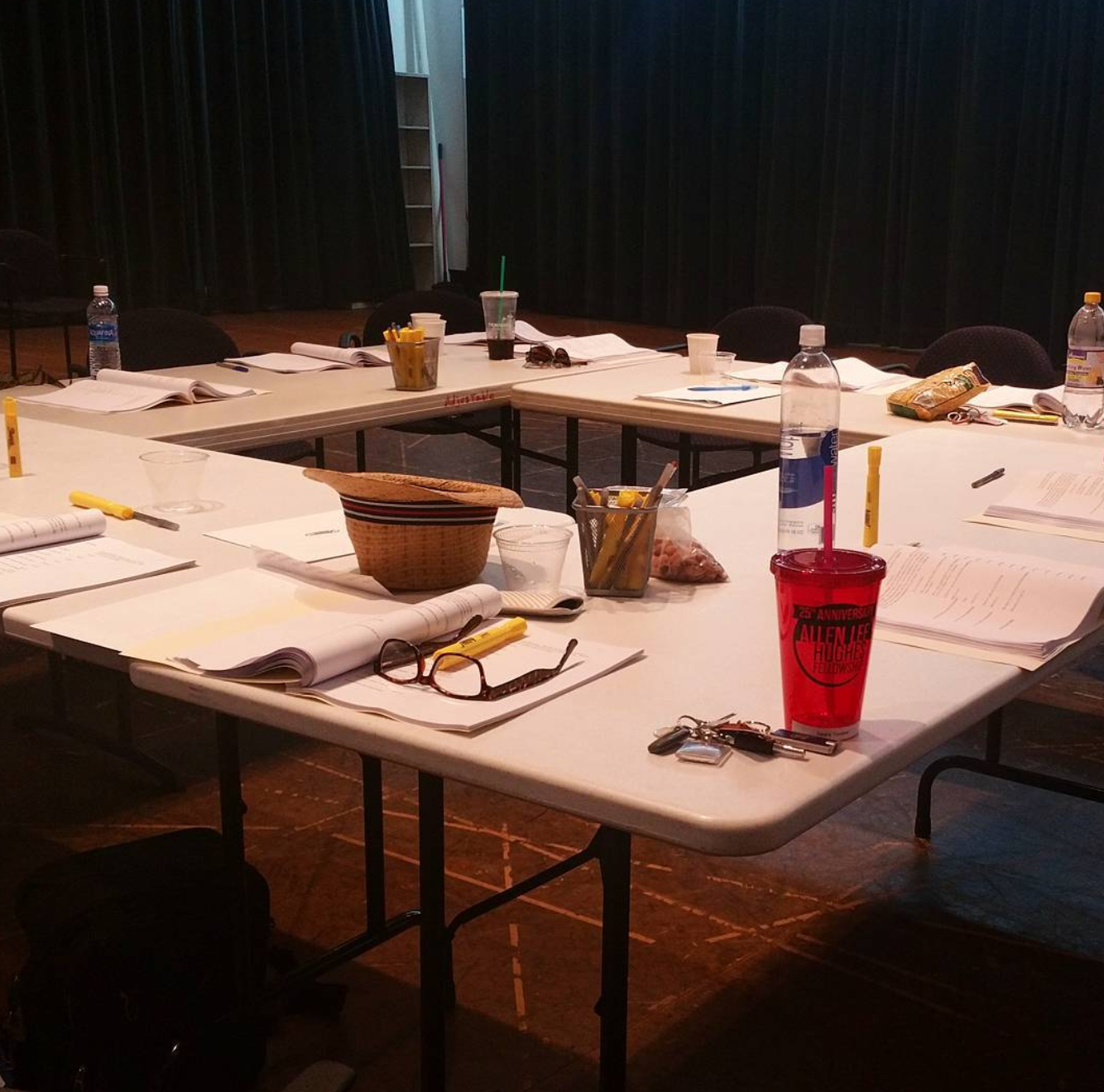
Photo of the Sovereignty workshop, 2016 (Ignore the bad Instagram filter. It was a different time.)
I sat calmly at the table with that draft of Sovereignty (then titled I Dream in Cherokee) and waited for the other Native artists to arrive, including DeLanna Studi (who is now a dear friend and collaborator). The most impactful part of that workshop though, was what happened outside of rehearsals.
Molly and Mary Kathryn would meet in Molly’s office to discuss the play each day, and I was invited to attend. Still on that high from finally meeting and being in space with other Native artists, I happily sat across from them, completely unaware of the radicalization I was about to experience. When the door shut and Molly began with her notes, I witnessed Mary Kathryn advocate for the needs of her play and her people’s story with the artistic director of one of the country’s largest and most important institutions. I was in awe of her. She held so much power. She rejected feedback that didn’t serve the play she was writing. She asked questions back. She wasn’t concerned about making her play follow colonial structures or conventions - and she wasn’t concerned about her insistence impacting Molly’s decision to program her play as a future production. I had never seen a Native person at an institution, their first Native artist at that, push back and stand firmly within themself.
By the end of the week, I too was offering feedback, affirming Mary Kathryn, and asking my own questions of the institution. Before she left, Mary Kathryn told me to never let an institution make me small, and from that moment on, I never was again.
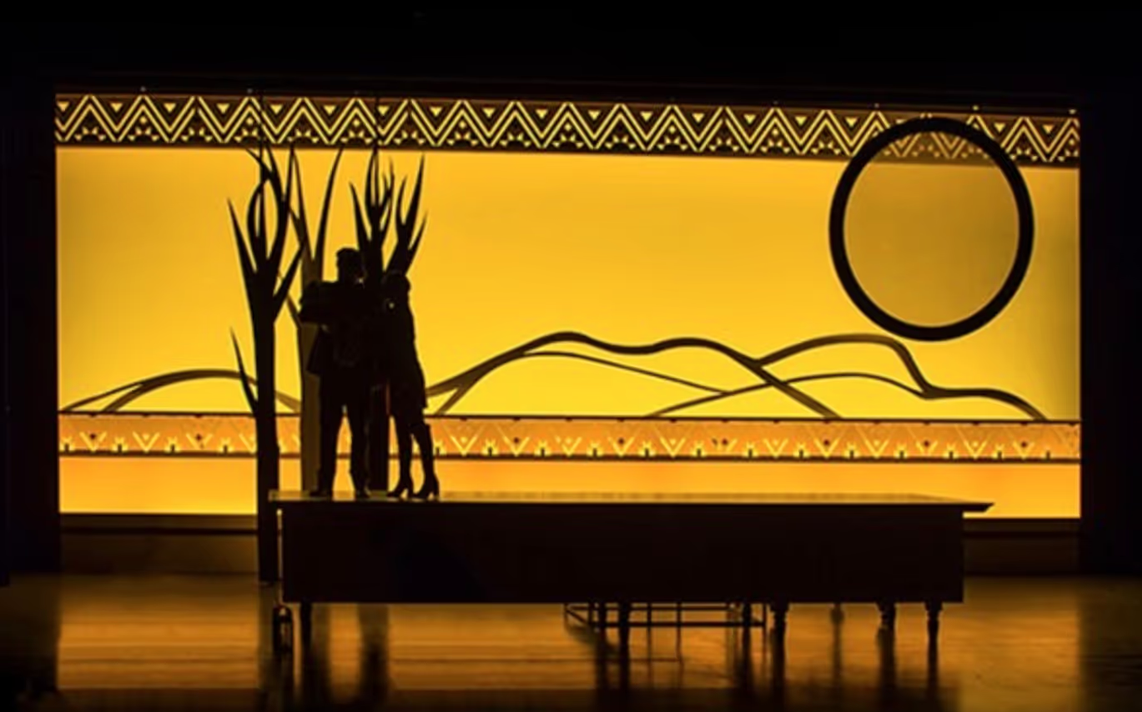
Jake Waid and Kyla Garcia in Sovereignty, directed by Molly Smith, at Arena Stage, 2018. C. Stanley Photography.
While I had moved back to Oklahoma at the end of my contract months earlier, I saved enough money to fly out to D.C. to see the premiere. I wasn’t going to miss that monumental moment. When I sat in my seat, I noticed some audience members near me, staring, and I took note of the severe lack of visible people of color in the audience. But I tried to ignore them as the lights went down. Throughout the first act, I clocked people looking at me, and again, I tried to ignore it. As the lights came back up for intermission, a man finally turned to me and said, “Okay, tell us. When do you pop up and go on stage?” Then another woman behind me jumped in and said, “Please tell us! We’ve been waiting for you!” I looked around to see about a dozen people also looking at me, expectantly. I smiled and said, “Oh no. I’m just an audience member. Like all of you.” I then was met with a mix of confused and disappointed responses.
These audience members attending the first-ever Native play, not just at Arena Stage but in Washington, D.C. as a whole, assumed that I was in the cast. They had never seen a Native person in the theater before, so the thought that I could possibly be a fellow patron just like them could not cross their minds. And for me, it was a jarring realization that the Native play I had been so dedicated to was not for me. It was not for us. I was not the target audience for the first Native play I ever saw. That kind of heartbreak still lives with me - and it gets exacerbated every time an institution does not value the sovereignty of our stories.
In the decade since that experience, I’m so happy that there have been more productions of Native work with Native people as the target audience. However, the question of who is actually at the center of these stories remains. The answer is two-fold: the institution's idea of “Nativeness” because of the lack of Native leadership on creative teams.
SARAH
Thanks to our United States Supreme Court.
BEN
You don’t like the Court.
SARAH
I respect it.
BEN
You’re like a Catholic that hates the Vatican.
SARAH
It’s hard to worship an institution that always decides against you.
Sovereignty by Mary Kathryn Nagle
In the seasons following Sovereignty at Arena Stage, institutions like Yale Repertory Theatre, Oregon Shakespeare Festival, and Playwrights Horizons all produced a Native playwright for the first time. None of those productions had a Native director. Few of them even had a single Native artist on their creative teams. That still largely remains the case. It’s difficult to put into words how we’re still stuck in time. I feel as though I am still living in the monumental moment that was January 2018 because there have been so few “monumental” steps forward since. Where are the all-Native creative teams? Where are the full Native casts on Broadway? Where are the scores of Native artists being accepted into prestigious training programs? Where are the Native artistic directors of LORT theaters? Where are the foundational Native artists like Spiderwoman Theatre in theatre history curriculums? Where are we?
The thing is, we know where we are. And we know why.
The critical breakdown begins in one of two ways: either programming work that is “about” Native people but not authored by a Native artist and/or hiring a non-Native director without the necessary analysis of our sovereignty.
If theaters choose to program non-Native playwrights’ takes on Native identity and cultures, how can we expect to eliminate the use of redface, stereotypes, and narratives that continue to erase us? How can we expect the field to address the severe equity gap for Native artists when they continue to throw their resources behind non-Native artists? How can we expect theaters to actually abide by their EDI statements when the work stops at a land acknowledgement?
If a director does not understand how we tell our stories and why we tell them the way that we do, how can we expect that director to then hire artists who do understand? How can we expect a director to effectively communicate to theatre leaders about the unique needs of a Native-authored play? How can we expect the theatre to then market the play without harming Native people? How can we expect non-Native audiences to challenge their internalized settler-colonialism and move towards understanding decolonization and Tribal Sovereignty? How can we expect an unprecedented moment like Sovereignty to ignite unprecedented change when nearly a decade later we’re still stuck in the same place in time, having the same conversations, demanding the same calls to action, and writing the same think pieces about what the future should look like?
This fall, the Native Theatre Movement will be dropping comprehensive data on our representation throughout the national theatre industry. Since Sovereignty this country has averaged 1 to 3 Native-authored productions a year. One to three. Out of thousands of plays at hundreds of theaters. The number of theaters that have produced multiple Native-authored plays in that same time is less than five. Five. We truly are at the beginning of Native theatre’s inclusion into the national landscape. The frustration is that we’ve been at the beginning for decades.
WAITE
…When we leave, they win. Because when we’re gone, they get to tell our story. And if you ask me, I think that’s what Sarah’s scared of. She’s terrified that folks will look at her, and they’ll know. They’ll know her story. But me, I’m just the opposite. I’m terrified that when I die, no one will know mine.
Sovereignty by Mary Kathryn Nagle
So what now? Do I write an optimistic and hopeful call to action that will somehow inspire the field to finally take us up on the myriad strategies we’ve been offering for years? Do I share a deeply personal story to show how even through all these challenges I still create? Do I draw the parallels between justice movements and sovereignty in our stories?
No. Because all of that work has already been done. Those articles, interviews, books, think-pieces, YouTube videos, etc. already exist. You can click around on our website to find so many of those linked already. Yet despite all that work, all these Native artists voicing the same issues for all this time, we are still stuck here.
So instead I’ll end with a piece of advice from my grandmother: “They say that you can lead a horse to water, but you can’t make it drink. But sometimes, you need to just drink the damn water.”