
Read: Better One or Better Two? Why I Teach All the Real Indians Died Off Before I Teach Theatre
A reflective essay by co-Initiator Daniel Leeman Smith
INTRODUCTION
Halito! If you’re new here, I’m Daniel. I am a white-presenting, mixed-race Native – an enrolled citizen of
the Choctaw Nation of Oklahoma, and I’m also of Mvskoke descent. For July’s NDN Bookclub, I am
offering an introduction to a truly no-frills but accessible and vital read that lays the groundwork for
achieving our core mission at the Native Theatre Movement, which requires a shift in how people think
about, represent, and engage with Natives. That book is Roxanne Dunbar-Ortiz and Dina Gilio-
Whitaker’s 2016 text All the Real Indians Died Off: And 20 Other Myths About Native Americans. But,
before I talk to you about it, I need to ground you a little more in who I am, how I came to the book, and
how I use it in my work as a theatre maker and academic. I am also going to treat this book review a little
bit more as an essay, my musings on why the book is important, because the reality is that the book is
quite literally a pragmatic list that sounds exactly like what it is. The brilliance lies in its deceptively
simple structure. By organizing the text around twenty-one persistent myths, Dunbar-Ortiz and Gilio-
Whitaker create an accessible entry point into Native studies while simultaneously exposing how deeply
colonial assumptions permeate American historical consciousness.
ADJUSTING THE PRESCRIPTION
For the past four years, I have had the great fortune of serving on the faculty of the NYU Tisch School of
the Arts in the Department of Drama. Among the courses I have taught for the department is a class called
Approaching Indigenous Theatre, which I inherited from a dear friend and colleague who launched the
class the previous academic year at the request of a Native student who wanted to be seen in their entirety
and to have their culture and identity not only reflected in, but actively a part of their theatre training.
When my friend was named the Associate Chair, and later full-on Chair, of the department, he asked me
if I would take over the class. His new workload meant that he would be teaching much less, and he felt
that, as a self-identified Mestizo Colombian, he might not be the best person to teach a class on
contemporary Native North American Theatre. I was given the freedom to design the course in any way I
wanted, provided it was within the container of the course description previously approved by NYU,
which exists with many other special-topic, upper-level literature courses under the umbrella Theatrical
Genres. And so I thought about the meaning of the title of the course and what my strengths as an artist
and scholar are – I work primarily as a director developing new Native American plays, but I am also a
playwright myself, a dramaturg, and a producer. I also understand that there is a paradigm difference, a
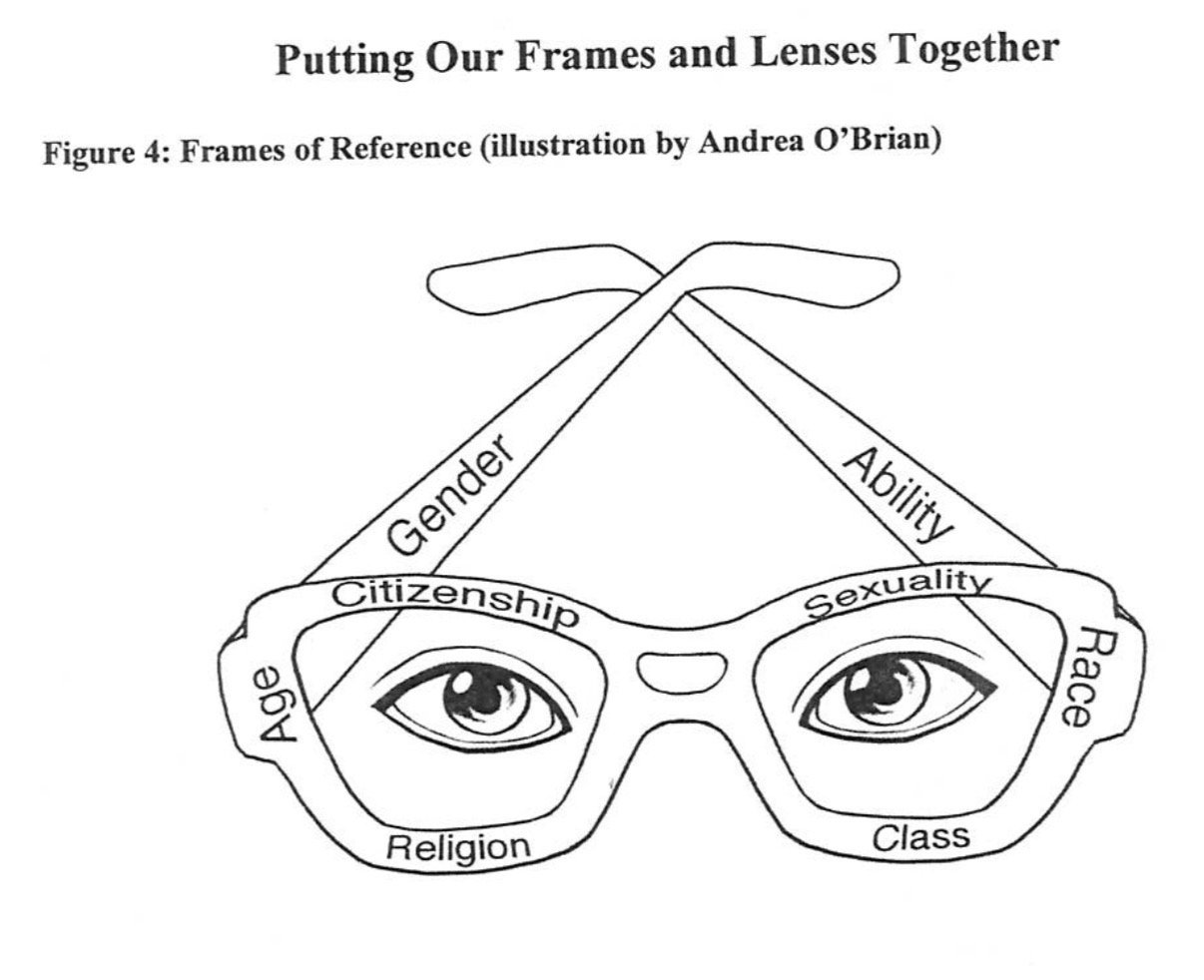
difference in ontology, or how Natives and non-Natives exist and move through the world. Scholar Robin
DiAngelo uses the metaphor of eyeglasses to talk about how we see the world. The frames are comprised
of things we don’t get to change about ourselves, and the lenses are the things we can change. So, in
taking on this class, I needed first to adjust my students’ prescriptions so they could actually understand
the plays we read, even though they are all universally understandable from a human
standpoint – specificity is the spice of life, ya’ know? And so, Dunbar-Ortiz and Gilio-Whitaker’s text has
become indispensable in my classroom because it clearly outlines the faulty narrative told about Natives
in this country by enumerating the myths compiled in service of controlling the land we refer to as Turtle
Island. All of these myths are challenged by the plays my students read in class.
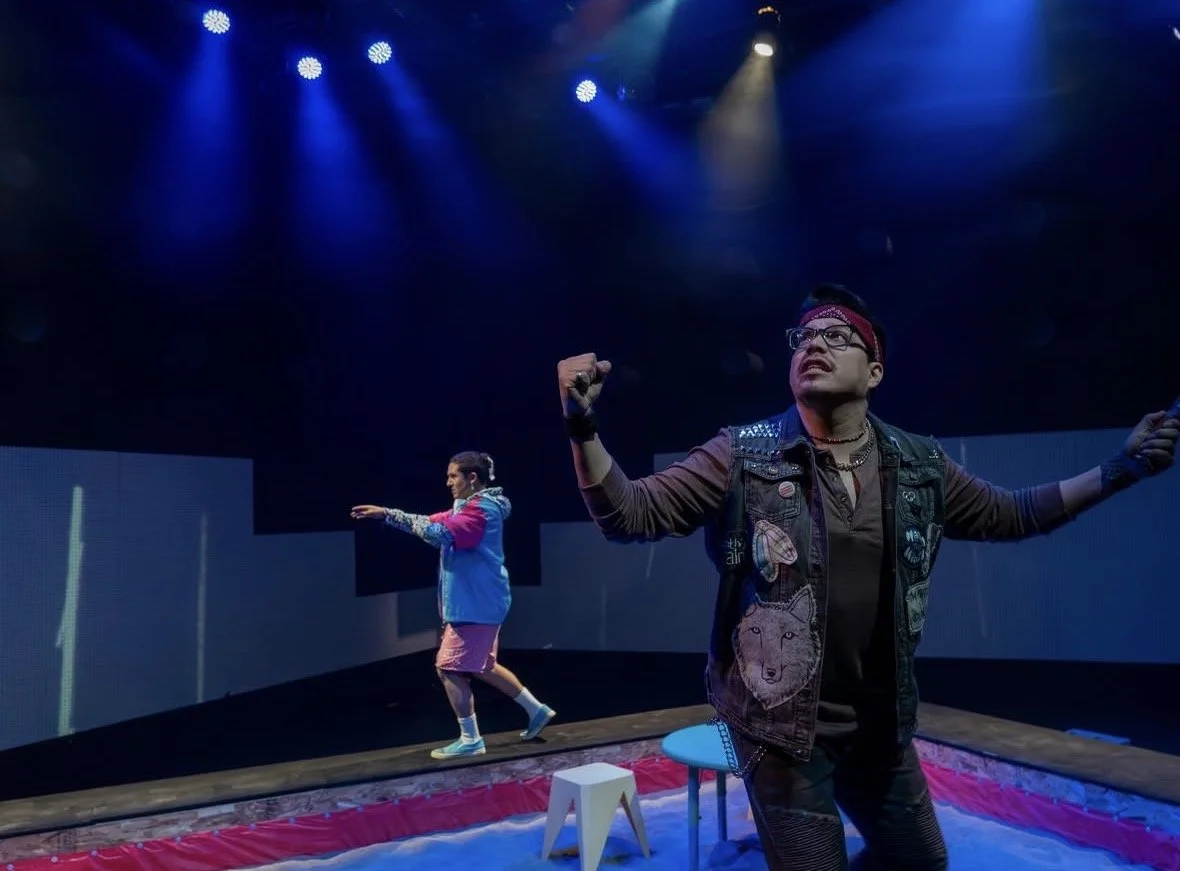
Anthony Anaya-Gorman (Navajo Nation) and Kenny Ramos (Barona Band of Mission Indians) in Pueblo Revolt by Dillon Christopher Chitto directed by Daniel Leeman Smith, Perseverance Theatre, 2026. Diggle, Scenic Designer. Sean-Joseph Takeo Kahāokalani Choo, Sound Designer. Emma Deane, Lighting Designer. Ryan Anderson, Projections Designer. Asa Benally, Costume Designer. Marie Laster, Associate Scenic Designer. Photography by Aurélie Marie.
I have a lot of Native playwright friends who are making some of the most incredible plays. The field of
Native theatre in the United States is really booming in a way that it hasn’t since the scandal of The
Public Theater’s production and Broadway transfer of Bloody Bloody Andrew Jackson led to the demise
of the institution’s Native theatre program in the late 2000s. But we are still here; our work is gaining
traction again, and we’re riding on the shoulders of generations before us that include legendary folks like
Spiderwoman Theatre, Bill Yellow Robe, Hannay Geiogamah, and so many of our First Nations
neighbors to the North, Native Hawaiian and Alaskan cousins to the west, and countless others. Truly, the
number of Native theatre makers is astounding, and yet, we are frequently told these plays just don’t exist,
or that there aren’t enough Native artists to support making them, which is largely untrue. Dunbar-Ortiz
and Gilio-Whitaker don’t have a chapter titled “There Aren’t Enough Native Plays”, but perhaps they
should. It feels like the twenty-second myth. Like many of the myths in the book, it depends on the
assumption that Native people are relics rather than contemporary creators.
There is, however, a pipeline/accessibility issue around getting Native plays into the hands of the public
and on our stages. Still, there is no shortage of really good Native plays, nor is there a shortage of Native
actors, Native designers, Native artisans and technicians, Native producers, and the like. What there is is a
lack of due diligence of “mainstream” theatre makers seeking out relationships with Natives because most
Americans were taught growing up that we are extinct. So, in designing the previously mentioned class, I
first and foremost wanted to expose my students to as many contemporary Native American plays and
playwrights as I could. I wanted to let them know that there’s more out there than The Thanksgiving Play,
and that’s not a dig at Larissa FastHorse, whom I know, love, and adore. Even she has written other
plays! Please read them! Please produce them! Secondly, it is such a rare opportunity for students to
engage with living playwrights or even see a script at differing stages of development. Since I work all
over the country doing new play development, I am not only able to share these plays with my students,
with the permission of the playwrights of course because many are unpublished manuscripts, but I am
able to bring many of the playwrights into my class for the students to have conversations about their
work, which has the added benefit of letting the students see how diverse Natives are, and how wide
ranging our cultures and experiences are. Ever the school marm (I was a classroom teacher for nearly a
decade), I always want to avoid being embarrassed by my students with guests in the room, so I needed to
ensure that they were literate in Native history, worldviews, cosmologies, and dramaturgies. So the first
third of the class is designed basically as a crash course in Native studies needed to give my students the
proper prescription lenses with which to view the material we read so they don’t put their foot in their
mouth when my friends roll up to talk to them.
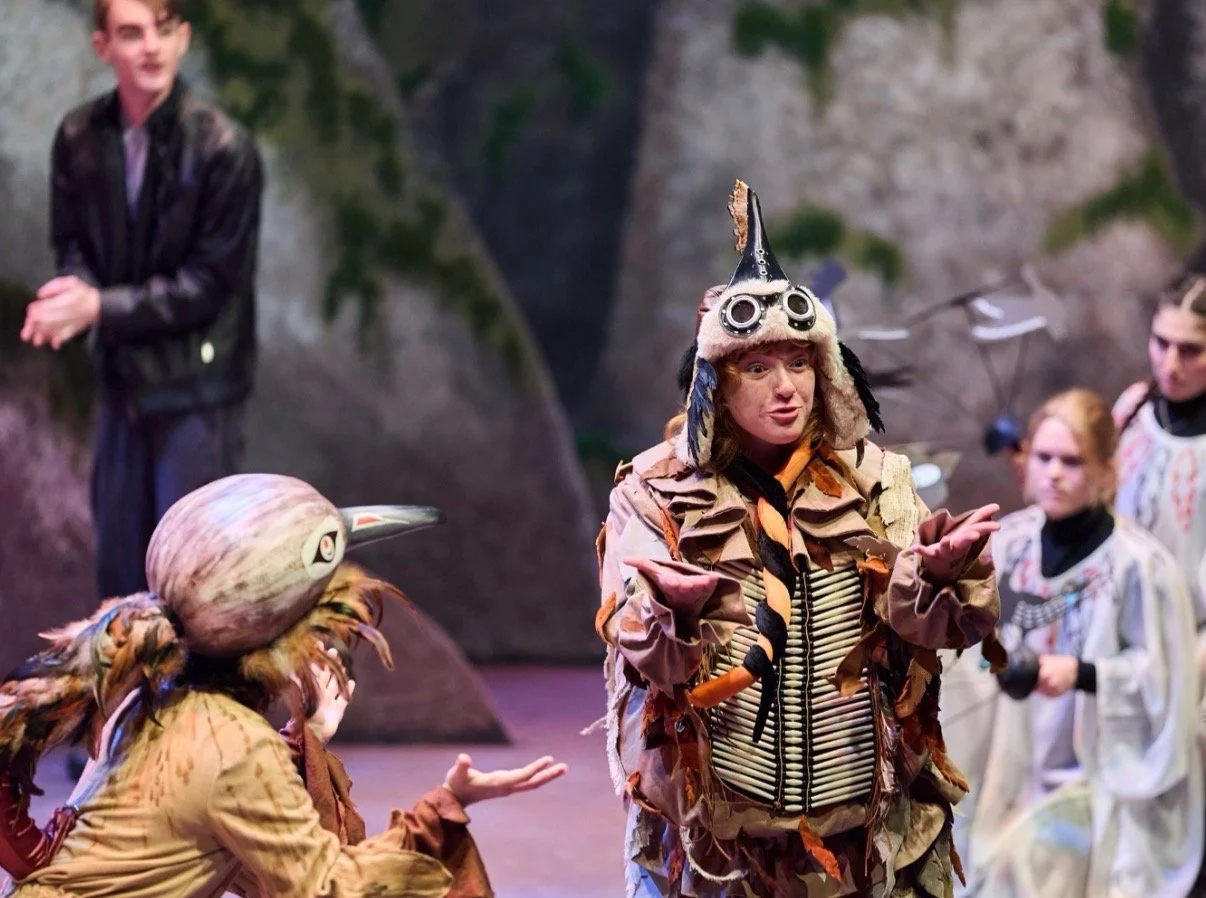
Maxine Cavallini (Cherokee Nation of Oklahoma) in Yvette Nolan’s The Birds, directed by Daniel Leeman Smith, University of Oklahoma, 2026. Terry Lee, Music Director. Dawn Avery, Composer. Afsaneh Aayani, Puppet Designer. Elizabeth Elliot, Scenic Designer. Lloyd Cracknell and Natalie Lane, Costume Designers. Mathieu Gay, Lighting Designer. Madison Heckelsberg, Sound Designer. Isabella Woodson, Production Dramaturg. Dr. Kate Bussell, Violencee and Intimacy Designer. OU Staff Photographer.
THE FIRST MYTH WALKS INTO MY CLASSROOM
In case this thought hasn’t already crossed your mind, in a class about Native American plays, we talk a
lot about race. Every semester my classroom quietly demonstrates the first myth in Dunbar-Ortiz and
Gilio-Whitaker’s book before we’ve even opened it. My students aren’t responding to me so much as they
are responding to the image of “the Indian” they inherited long before they arrived at NYU. My favorite
way to start the first class is to introduce myself in Choctaw and then ask the class how many of them
thought a white Native would be teaching the course (sometimes I refer to myself as a WIndian because I
enjoy whimsy and portmanteaus). There’s a wide range of emotions on everyone’s faces, and then they
get quiet, lean in, and we start to have some really meaningful conversation. Now, as anyone who is
mixed-race will tell you, being mixed is a quiet sort of conundrum of a life; as humans, we read one
another first and foremost, based on appearances, unless we’re literally blind, and then our other senses
take the lead. We’re not supposed to judge a book by its cover, but we do, and we can’t help but do it,
because humans are wired that way. The human brain is still adapting to this ridiculous world of
modernity which, biologically speaking, we have simply not had enough time to evolve for, and so we
have this vestigial set of cognitive shortcuts, instincts if you will, that our ancestors used to spot threats
and stay alive, chief among them (multi-layered pun very much intended) is the ability to make quick
judgements about people, places, and things based on the little visual information we have in a first
encounter. In psychology, this is called thin slicing. Knowing that this is a normal biological response, as
many psychologists point out, does not excuse rudeness, racism, or discrimination of any kind. As a result
of preconceived notions about appearance and culture, mixed-race folks often find ourselves struggling
with identity crises, which I would argue is really a crisis of belonging. I struggled with this in my youth.
Am I enough? Am I Native enough? Am I white enough? Where do I fit? I straddle both worlds, but
because I look a certain way, people often treat me a certain way, in both communities. As I approach my
fourth decade on this planet, I have let go of those questions because I know where I come from, who I
come from, who loves and cares for me, that I am enough, and that two truths can exist at the same time.
As the saying goes, we contain multitudes. And so, I have learned to harness my outward presentation and
lived experience as a Chahta ohoyo as a secret weapon for undoing some of the injustice I see in the
world. Other people’s thoughts and expectations of me are none of my business – I have the choice each
day to decide if I want to pick up and carry other people’s baggage, and I’m a spoiled princess, so I leave
their baggage where it belongs, with them.
At the start of the semester, I need my students to understand what implicit bias is, which is tied to that
thin slicing we talked about earlier, and that it is a thin slice of the story, but rarely is it the whole story,
and very often it leads to misconceptions and prejudice, which are found in all communities, not just
white ones. Sometimes our initial read of people is good, because the uneasiness we feel is our intuition
and it’s keeping us safe from harm. Still, there are times it is actually a faulty narrative created by our
forebears with ill intentions. It can cause us to harm others by acting on our prejudices (biases), and that
action is then called discrimination. Often we are trapped in a particular way of thinking because we have
been trained, or socialized, by the communities we live in and the media we consume to believe, think,
and act in certain ways. The bias then is implicit because it is unseen – it’s second nature. We can’t do
better until we know better. Explicit bias, on the other hand, is when you know better but you do the
shitty thing anyway. So we have to practice discernment. We have to work to meet new people and learn
new things, and update the prescription for the lenses we use to view the world so we don’t hurt people.
As the Spanish writer Miguel de Unamuno famously quipped, “fascism is cured by reading, and racism is
cured by traveling.” I don’t have the luxury of taking my students on trips out of the city, but I do have
the luxury of introducing them to new readings and bringing people from other communities to them. We
often think that our biases mean there’s something wrong with us, and that’s precisely why this book
works so well pedagogically. It doesn’t shame readers for inheriting these myths; it asks them to notice
them, trace where they came from, and replace them with a more accurate understanding of Native history
and contemporary life.
LEARNING TO SEE
You’ve probably heard it said that race is a social construct. That doesn’t mean skin color isn’t real or that
we don’t notice it. Of course we do. What it means is that the categories we’ve attached to those physical
differences — and the meanings we’ve assigned them — were created by people rather than nature.
In the United States, race has historically been treated as though it described distinct biological groups,
when in reality it has always been entangled with politics, power, and colonialism, and even who is
considered “white” has changed from census to census. We often blur race, ethnicity, culture, and
nationality together, flattening identities that are actually quite complex. I am a white-presenting Native
American, a dual citizen of the United States and enrolled citizen of the Choctaw Nation of Oklahoma,
culturally Chahta, of Mvskoke descent, and also white. Those truths coexist, even if our racial categories
struggle to hold them.
The danger of racial thinking is not simply that it notices difference; it insists that appearance tells us who
people are, where they belong, and what rights they should have. Historically, those ideas were reinforced
through pseudoscientific theories like eugenics, which attempted to rank human beings into hierarchies of
value. Modern genetics has thoroughly dismantled those claims. Human beings are remarkably alike, and
the genetic variation within so-called races is often greater than the variation between them. Dunbar-Ortiz
and Gilio-Whitaker begin with the myth that “All the Real Indians Died Off” because that myth depends
on this very kind of racial thinking. If “Indian” is understood as a racial category rather than as a living
constellation of sovereign nations, cultures, and kinship systems, then anyone who fails to match the
imagined stereotype becomes suspect. The myth isn’t simply historically false — it becomes a political tool
that erases Native presence in the present.
What impressed me most when I first encountered All the Real Indians Died Off was not simply the list of
myths themselves. Most Native people have heard every one of them before. Rather, the book
demonstrates that these myths are not isolated misunderstandings. They work together. They reinforce
one another. And collectively they serve a political function. If Native people disappeared, then
settlement appears inevitable. If Native nations no longer exist, then treaty obligations become historical
curiosities instead of living legal commitments. If Native identity is reduced to race rather than
citizenship, kinship, and sovereignty, then Indigenous political existence becomes easier to dismiss. The
myths are less about ignorance than about maintaining a particular story America tells about itself.
21 VISION CHECKS
I should probably introduce you to the myths, and as I do, I’m going to tie them back to the theatre by
imagining what their theatrical application and implications might look like. Just for S’s and G’s, I’m
going to try to tie them to our eyesight metaphor through what I’m calling vision checks. I’m sure you
will find more connections when you read the book.
Myth # 1: All the Real Indians Died Off
Theatrical application:
If audiences believe Native people no longer exist, then Native plays are assumed to be historical dramas
rather than contemporary stories. Living Native playwrights become invisible, Native actors are seen as
impossible to cast, and theatres convince themselves there simply “aren’t enough” Native artists to
produce the work.
Vision check:
This myth is like getting the wrong prescription. Everything looks just clear enough that you don’t realize
you’re seeing the world incorrectly until someone hands you the right pair of glasses.
Myth # 2: Indians Were the First Immigrants to the Western Hemisphere
This myth subtly denies Indigenous sovereignty by treating Native peoples as just another immigrant
group.
Theatrical application:
Land acknowledgments become symbolic gestures rather than acknowledgments of ongoing political
relationships and actions taken to uplift Native artists and communities. Indigenous stories become part of
America’s multicultural mosaic instead of expressions of sovereign nations with distinct histories and
responsibilities.
Vision check:
This myth is like using binoculars to search the horizon for a Native port of entry so you never have to
look in the mirror.
Myth # 3: Columbus Discovered America
Theatrical application:
Theatre history courses often begin with Europe. Indigenous performance traditions are treated as
prehistory, anthropology, or ritual rather than theatre worthy of study alongside Sophocles, Shakespeare,
the Natyasastra, or Noh.
Vision check:
This myth is like wearing a monocle. It narrows your field of vision while convincing you you’re seeing
more clearly than everyone else.
Myth # 4: Thanksgiving Proves the Indians Welcomed the Pilgrims
Theatrical application:
School plays become one of the earliest places children rehearse settler mythology. The Thanksgiving
pageant teaches performance long before students ever step onto a theatre stage. (See The Thanksgiving
Play)
Vision check:
This myth is like costume glasses with the fake nose attached. Everyone knows they’re pretend, but
somehow we keep putting them on every November.
Myth # 5: Indians Were Savage and Warlike
Theatrical application:
Native characters are frequently written as obstacles to civilization or as inherently violent figures,
making it difficult for audiences to recognize Indigenous diplomacy, humor, tenderness, or intellectual
traditions.
Vision check:
This myth is like trying to drive with a fogged windshield. Every shadow looks like a threat because you
can’t actually see what’s in front of you.
Myth # 6: Indians Should Move On and Forget the Past
Theatrical application:
Audiences often ask why Native plays “keep talking about colonization” while happily watching endless
productions about World War II, the Holocaust, the American Revolution, or Greek tragedy. Some
histories are treated as timeless; Indigenous history is treated as baggage.
Vision check:
This myth is like a broken View-Master. It keeps clicking, but the slide never changes, so the breadth of
history is never seen.
Myth # 7: Europeans Brought Civilization to the Backward Indians
Theatrical application:
Native theatre is often evaluated according to European dramatic conventions, as though Western realism
were the universal standard instead of one theatrical tradition among many.
Vision check:
This myth is like putting an eye patch over the eye that witnessed Indigenous civilizations and insisting
the remaining eye sees the whole picture.
Myth # 8: The United States Did Not Have a Policy of Genocide
Theatrical application:
If genocide is never acknowledged, Native grief appears exaggerated, Native anger appears irrational, and
Native resilience becomes inexplicable. Theatre loses the historical context necessary to understand the
stakes of Indigenous storytelling.
Vision check:
This myth is like refusing cataract surgery because you’ve grown comfortable with the blur.
Myth # 9: US Presidents Were Benevolent or at Least Fair-Minded Toward Indians
Theatrical application:
Historical dramas frequently celebrate presidents while omitting or sanitizing their Indian policies,
reinforcing heroic national narratives at the expense of historical complexity.
Vision check:
This myth is like a glamour filter on your phone. It smooths out every blemish until history becomes
unrecognizable.
Myth # 10: The Only Real Indians Are Full-Bloods, and They Are Dying Off
Theatrical application:
Casting directors, critics, and even audiences become amateur blood-quantum inspectors, deciding who
“looks Native enough” to tell Native stories while ignoring citizenship, community, and kinship.
Vision check:
This myth is like those novelty X-ray glasses advertised in comic books—they promise to reveal who the
“real Indians” are, but they’re complete nonsense.
Myth # 11: The United States Gave Indians Their Reservations
Theatrical application:
Native nations are framed as recipients of government generosity rather than sovereign peoples
negotiating, resisting, and surviving the theft of their homelands. Imagine all of the Native cities and
performance spaces we would have if our land hadn’t been stolen. The Lingít in Alaska even had
amphitheaters.
Vision check:
This myth is like looking through the wrong end of a telescope. Theft suddenly looks like generosity
because everything has been made smaller.
Myth # 12: Indians Are Wards of the State
Theatrical application:
Native artists are too often treated as beneficiaries of institutional generosity rather than equal
collaborators whose expertise, labor, and leadership deserve compensation and authority.
Vision check:
This myth is like someone insisting on holding your flashlight while telling you where to walk.
Myth # 13: Sports Mascots Honor Native Americans
Theatrical application:
The entertainment industry frequently mistakes appropriation for appreciation. Wearing regalia,
borrowing ceremonies, or “honoring” Native aesthetics without relationship or consent follows the same
logic as mascots.
Vision check:
This myth is like putting on someone else’s prescription glasses because you think they look cool. They
weren’t made for you, and wearing them gives everyone a headache.
Myth # 14: Native American Culture Belongs to All Americans
Theatrical application:
Productions often assume Indigenous stories, songs, ceremonies, and designs are part of the public
domain rather than belonging to living communities with protocols governing their use.
Vision check:
This myth is like borrowing someone’s contact lenses because you think vision should be shared. That’s
not how eyes — or cultures — work.
Myth # 15: Most Indians Are on Government Welfare
Theatrical application:
When Native artists receive grants or fellowships, they are sometimes viewed as beneficiaries of charity
instead of highly competitive artists earning recognition through their work.
Vision check:
This myth is like assuming everyone wearing reading glasses must be poor because they got them at the
drugstore.
Myth # 16: Indian Casinos Make Them All Rich
Theatrical application:
Because a handful of tribes have become economically successful, theatres sometimes assume Native
communities no longer need investment, commissioning, or institutional support, ignoring the tremendous
diversity of tribal economies. Sometimes producers say things like, could you get some tribal money for
this production?
Vision check:
This myth is like seeing one pair of designer frames and assuming everyone in the waiting room can
afford them.
Myth # 17: Indians Are Anti-Science
Theatrical application:
Indigenous knowledge is often dismissed as spirituality or folklore rather than recognized as sophisticated
systems of environmental observation, governance, medicine, agriculture, and ecological
stewardship — all of which can profoundly shape theatrical practice.
Vision check:
This myth is like insisting telescopes are superior to microscopes. They’re both scientific
instruments—you just use them to understand different parts of the universe.
Myth # 18: Indians Are Naturally Predisposed to Alcoholism
Theatrical application:
There is no known genetic trait that links being Native to Alcohol Use Disorder. Native characters too
often become defined by addiction narratives, crowding out stories about joy, romance, science, comedy,
ambition, parenthood, queerness, and ordinary life.
Vision check:
This myth is like color blindness. Once you reduce every Native story to addiction, whole dimensions of
human experience disappear from view.
Myth # 19: What’s the Problem with Thinking of Indian Women as Princesses or Sqauws?
Theatrical application:
Native women are routinely flattened into opposing stereotypes — the noble princess or the degraded
squaw — leaving little room for the complexity, humor, leadership, sexuality, and humanity that
characterize actual Indigenous women. There’s no such thing as an Indian princess, unless you’re talking
about the beauty pageant circuit, and both terms, Indian princess and squaw, are racial slurs.
Vision check:
This myth is like those funhouse mirrors at the carnival. One reflection stretches Native women into
fantasy, the other compresses them into stereotype. Neither resembles the person standing in front of the
glass.
Myth # 20: Native Americans Can’t Agree on What to Be Called
Vision check:
Theatres often become so anxious about terminology that they avoid producing Native work altogether,
mistaking respectful uncertainty for a reason not to build relationships with Native communities.
Vision check:
This myth is like spending the entire eye exam arguing over what to call the letters instead of trying to
read them.
Myth # 21: Indians Are Victims and Deserve Our Sympathy
Theatrical application:
The most compelling Native theatre rarely asks audiences for pity. It asks for relationship, accountability,
laughter, discomfort, and recognition. Indigenous artists are not simply telling stories of survival — they
are imagining futures.
Vision check:
This myth is like crying at a blurry photograph instead of cleaning the glass in the frame. Sympathy
without clarity and action changes nothing.
YOUR NEW PRESCRIPTION
All the Real Indians Died Off isn’t merely correcting facts; it’s helping readers replace the lenses through
which they’ve been taught to see Indigenous peoples. So what do you think? Are you ready for your new
prescription? Give it a read and let me know.
WORKS CONSULTED
For readers interested in exploring these ideas further, the following works trace the intellectual path
that informed this essay.
Galton, Francis. Inquiries into Human Faculty and Its Development. London: Macmillan, 1883.
Ambady, Nalini, and Robert Rosenthal. "Thin Slices of Expressive Behavior as Predictors of
Interpersonal Consequences: A Meta-Analysis." Psychological Bulletin 111, no. 2 (1992): 256–274.
Gladwell, Malcolm. Blink: The Power of Thinking Without Thinking. New York: Little, Brown and
Company, 2005.
Maroño, Abbie. "Why We Judge People by Their Appearances." Forbes. May 15, 2024.
https://www.forbes.com/sites/quora/2024/05/15/why-we-judge-people-by-their-appearances/.
DiAngelo, Robin. What Does It Mean to Be White? Developing White Racial Literacy. New York: Peter
Lang, 2016.
Fuentes, Agustín. Race, Monogamy, and Other Lies They Told You: Busting Myths About Human Nature.
Oakland: University of California Press, 2012.
Dunbar-Ortiz, Roxanne, and Dina Gilio-Whitaker. All the Real Indians Died Off: And 20 Other Myths
About Native Americans. Boston: Beacon Press, 2016.